FIFA
Why Hybrid Grass Took Over Major Football Venues
Stitching plastic fibres into a natural root zone solved the wear problem at large stadiums, and the reason it works is mechanical rather than botanical.
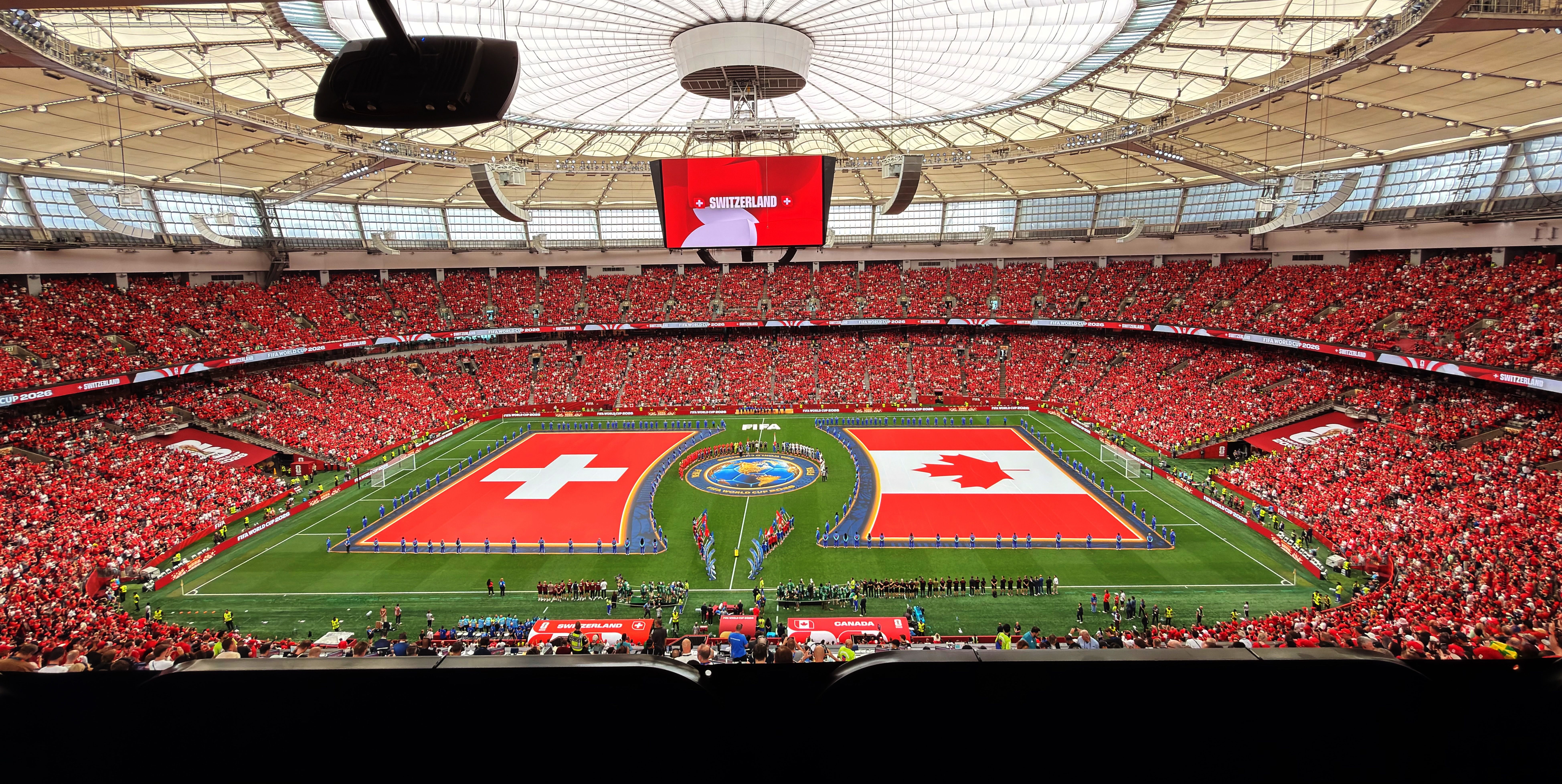
Most large football stadiums now play on a surface that is neither fully natural nor artificial. Hybrid turf combines living grass with synthetic fibres, and it spread because it fixed a specific failure of pure grass.
Natural pitches fail at the roots, not the leaf
When a pure grass pitch cuts up, what actually breaks is the mat of roots holding the top few centimetres of soil together. Once that mat tears, whole plates of turf lift under a stud.
Growth replaces roots, but growth is slow in winter and slower still in shade, so a heavily used pitch loses root mass faster than it can rebuild it.
That deficit is why the same stadium can present a good surface in September and a broken one in February without anything else changing.
Fibres carry the load the roots cannot
Hybrid systems stitch fine synthetic fibres vertically into the root zone at close spacing, anchoring them well below the playing surface.
The grass then grows around and through them, and the fibres take a share of the shear force that would otherwise be carried by roots alone.
The visible surface is still living grass, but it now sits in a reinforced matrix that resists tearing even when root density has fallen.
Consistency is the competitive argument
A reinforced pitch degrades far more gradually, which means the surface a team meets late in a season resembles the one it met early.
For competitions that stage many matches at one venue in a short window, that stability is the whole point, because it removes conditions as a source of unequal treatment.
It also reduces the number of emergency relays, which are expensive and can force fixtures to move at short notice.
The trade-offs are real
Hybrid surfaces are considerably more expensive to install than seeded turf, and the fibres cannot be removed once stitched, so the decision commits a venue for years.
Maintenance also changes. Aeration equipment must work around the fibres, and renovation is done by fraise mowing the top layer rather than lifting and replacing turf.
Players describe the feel as firmer than deep natural grass, which is part of why cutting height and irrigation are used to soften how the surface plays.
Why it did not stay a stadium-only technology
Training grounds adopted hybrid pitches for the same reason stadiums did, since repeated small-sided work concentrates wear into a fraction of the field.
Some competitions also use it at venues that host other sports, where the surface must survive non-football loading between matches.
The result is that the elite game has quietly standardised on a surface that behaves consistently, which changes what tactical plans can assume about the ground underfoot.
Also by Michael Cox
- Advanced Analytics: How passing lanes Shapes rotation rates OutcomesClub Rankings
- Advanced Analytics: How rotation rates Shapes rotation rates OutcomesClub Rankings
- Advanced Analytics: How compact defensive blocks Shapes rotation rates OutcomesClub Rankings
- Advanced Analytics: How overlap runs Shapes rotation rates OutcomesClub Rankings